
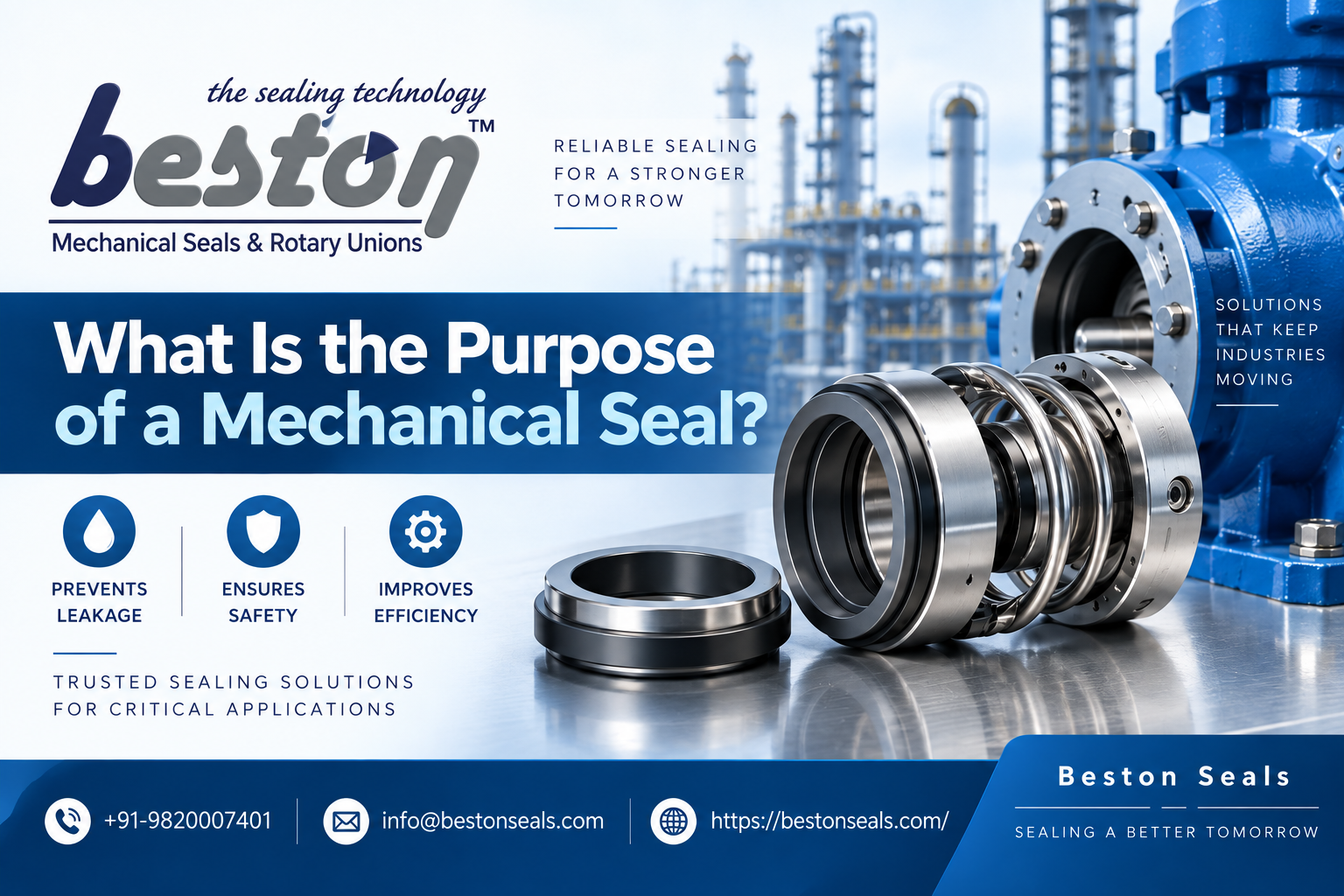
In pumps and other rotating equipment, even a small fluid leak can cause product loss, extra maintenance, equipment damage, safety concerns, and production interruptions. This is where mechanical seals play an important role. Their main purpose is to control leakage where a rotating shaft passes through a stationary pump casing or equipment housing.
A mechanical seal creates a sealing point between moving and stationary parts. It normally uses two carefully finished seal faces—one rotates with the shaft while the other remains stationary. A very thin fluid film between these faces helps with lubrication and heat control. When the seal is correctly selected and installed, it keeps process fluid inside the equipment while allowing the shaft to rotate efficiently.
Why Are Mechanical Seals Used?
The primary purpose of mechanical seals is leak control. Pumps may handle water, oils, chemicals, solvents, slurries, food products, and many other process materials. Allowing these fluids to escape around the shaft can be costly and, in some applications, dangerous.
Mechanical seals are therefore used in equipment operating under pressure, heat, speed, or demanding fluid conditions. They are commonly found in centrifugal pumps, mixers, agitators, reactors, and other rotating machinery.
Compared with traditional packing, a properly designed mechanical seal can provide much lower visible leakage and reduce friction around the shaft.
How Does a Mechanical Seal Work?
Although designs vary, the working principle is fairly simple. A rotating seal face and a stationary face are pressed together by spring force and operating pressure. Secondary sealing elements, such as O-rings or bellows, stop fluid from passing around other areas of the assembly.
In most applications, the seal faces should not run completely dry. A microscopic film of fluid between them provides lubrication and helps control heat. Correct installation and operating conditions are essential because an unsuitable seal can overheat, wear quickly, or fail early.
Key Purposes of Mechanical Seals
Mechanical seals do more than control leakage. They also support several important operating goals:
1. Improving Workplace Safety
Containing process fluids helps keep the area around pumps cleaner and safer. This is especially important when machinery handles hot, corrosive, flammable, or hazardous liquids.
2. Reducing Product Loss
In continuous processes, even a small recurring leak can result in significant material loss over time. Effective sealing keeps valuable process fluid within the system.
3. Protecting Equipment
Leaking fluids can affect bearings, shafts, motors, and nearby components. Proper sealing helps protect the machinery around the seal.
4. Supporting Reliable Production
Seal failure can stop a pump or production line. Selecting a seal according to the fluid, pressure, temperature, and shaft speed can reduce avoidable maintenance interruptions.
5. Limiting Environmental Release
Industries handling chemicals, oils, and other process liquids need to control unwanted releases. A suitable sealing arrangement helps minimise fluid escaping into the surrounding environment.
Choosing the Right Mechanical Seal
There is no single seal suitable for every application. That makes application-specific selection one of the most important steps in seal performance and reliability. Engineers normally consider the fluid, temperature, pressure, shaft speed, solids content, equipment design, and chemical compatibility before selecting a seal.
Seal-face and elastomer materials are equally important. Experienced Mechanical seals manufacturers therefore look beyond dimensions and consider the actual operating environment.
Why Manufacturing Quality Matters
Mechanical seals depend on precision. A dependable manufacturer should understand both the product and the conditions in which it will operate.
Beston Seals offers pusher, non-pusher, cartridge, split, agitator, mixer, and other industrial sealing solutions. Its website also highlights technical support for seal selection based on factors such as pressure, temperature, shaft speed, and process-fluid characteristics.
For businesses searching for a Leading Mechanical Seals Manufacturer, the important considerations should include technical suitability, manufacturing quality, material compatibility, application knowledge, and dependable support.
Conclusion
The purpose of a mechanical seal is straightforward but critical: it controls leakage between rotating and stationary parts while allowing machinery to operate efficiently. The right seal can support safety, equipment protection, reliable production, reduced product loss, and better maintenance planning.
Good performance, however, depends on correct selection, installation, materials, and operating conditions. Beston Seals helps industrial users choose mechanical seals suited to different applications, with a focus on reliable sealing performance and practical operating requirements.
Frequently Asked Questions
What is the main purpose of a mechanical seal?
The main purpose of a mechanical seal is to control fluid leakage between a rotating shaft and a stationary housing. It helps keep process fluids inside pumps and other rotating equipment while allowing the shaft to move efficiently.
Where are mechanical seals commonly used?
Mechanical seals are commonly used in pumps, mixers, agitators, compressors, reactors, and other rotating equipment. They are widely used in industries such as chemical processing, water treatment, pharmaceuticals, food processing, oil and gas, and manufacturing.
What causes mechanical seals to fail?
Mechanical seals may fail because of dry running, excessive heat, incorrect installation, vibration, shaft misalignment, unsuitable materials, abrasive particles, or operating conditions outside the seal’s intended limits.
How long can a mechanical seal last?
There is no fixed lifespan for a mechanical seal. Its service life depends on operating pressure, temperature, shaft speed, fluid properties, installation quality, lubrication, alignment, and maintenance.
What is the difference between a mechanical seal and gland packing?
Gland packing uses compressed packing material around the shaft and normally allows some controlled leakage. A mechanical seal uses precision sealing faces and generally provides better leakage control with lower shaft friction.
How do you choose the right mechanical seal?
The correct seal depends on several factors, including fluid type, operating pressure, temperature, shaft speed, shaft size, chemical compatibility, solids content, and equipment design. Working with experienced Mechanical seals manufacturers can help ensure the seal matches the application.
Can mechanical seals be used for high-temperature applications?
Yes. Mechanical seals can be designed for high-temperature applications, but the seal faces, elastomers, metal components, and overall design must be suitable for the expected temperature and operating conditions.