
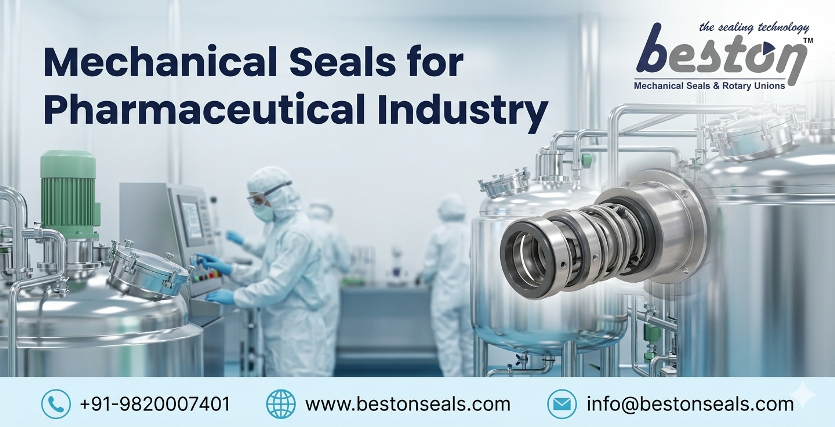
The pharmaceutical industry operates under some of the most stringent quality and hygiene standards in the world. From active pharmaceutical ingredient (API) production to sterile drug manufacturing, even the smallest contamination can compromise product safety, regulatory compliance, and brand reputation.
In such critical environments, mechanical seals play a vital role in ensuring leak-free, contamination-free, and hygienic operation of pumps, mixers, reactors, and agitators.
Selecting the right mechanical seal for pharmaceutical applications is not just about performance — it is about compliance, cleanliness, and reliability.
This guide explains how to choose the right mechanical seals for pharma applications, key compliance requirements, materials, and best practices for long-term performance.
Why Mechanical Seals Are Critical in Pharma Manufacturing
Pharmaceutical processes involve:
- Sterile fluids
- High-purity chemicals
- Solvents and APIs
- Sensitive formulations
- Clean-in-place (CIP) and steam-in-place (SIP) systems
Any leakage or contamination can lead to:
- Batch rejection
- Regulatory violations
- Product recalls
- Financial losses
- Safety risks
Mechanical seals help maintain:
✔ Product purity
✔ Zero contamination
✔ Controlled environments
✔ Process reliability
✔ Compliance with GMP standards
Key Requirements for Mechanical Seals in the Pharmaceutical Industry
Unlike general industrial applications, pharma seals must meet strict standards:
✔ Hygienic Design
Seals must prevent product accumulation and bacterial growth.
- Smooth surface finishes
- Crevice-free design
- Self-draining geometry
✔ Compliance with Regulations
Pharma seals must comply with:
- GMP (Good Manufacturing Practices)
- FDA regulations (for materials)
- USP Class VI standards
- EHEDG (European Hygienic Engineering & Design Group)
These standards ensure safety and hygiene.
✔ Cleanability (CIP/SIP Compatibility)
Seals must withstand:
- Cleaning-in-place (CIP)
- Steam-in-place (SIP)
- Sterilization cycles
Without degrading or losing sealing efficiency.
✔ Material Purity
All wetted parts must be:
- Non-reactive
- Non-toxic
- Resistant to chemicals and solvents
✔ Zero Leakage Requirement
Even minimal leakage is unacceptable in pharma processes.
Double seals or hygienic cartridge seals are often preferred.
Types of Mechanical Seals Used in the Pharma Industry
1. Single Mechanical Seals
Used in non-critical applications.
Applications:
- Water systems
- Utility pumps
Limitations:
- Not suitable for sterile or hazardous media
2. Double Mechanical Seals
Preferred in pharmaceutical production.
Benefits:
✔ Zero leakage
✔ Prevent contamination
✔ Suitable for toxic or sterile fluids
Used in:
- API processing
- Reactor systems
- Solvent handling
3. Cartridge Mechanical Seals
Highly recommended for pharma.
Advantages:
✔ Easy installation
✔ Reduced human error
✔ Hygienic design
✔ Minimal maintenance
Cartridge seals are widely used in cleanroom environments.
4. PTFE Bellow Mechanical Seals
Ideal for corrosive and solvent-based processes.
Benefits:
✔ Chemical resistance
✔ Non-reactive
✔ Suitable for aggressive APIs
5. Metal Bellow Mechanical Seals
Used in high-temperature sterilization systems.
Benefits:
✔ No elastomer contamination
✔ Handles thermal cycling
✔ Suitable for SIP processes
Material Selection for Pharmaceutical Seals
Material selection is critical to ensure compliance and longevity.
Seal Faces
Elastomers (FDA Approved)
- PTFE
- EPDM
- Viton (where applicable)
- Kalrez (high-end applications)
Metal Components
- SS316L (pharma-grade stainless steel)
These materials ensure:
✔ Chemical compatibility
✔ Sterility
✔ Long service life
Applications in the Pharmaceutical Industry
Mechanical seals are used in:
- API manufacturing systems
- Sterile fluid transfer pumps
- Reactor vessels
- Mixers & agitators
- Centrifugal pumps
- Solvent handling systems
- Filtration units
Each application requires a specific seal design.
How to Select the Right Mechanical Seal for Pharma Applications
Step 1: Understand the Process Fluid
- Is it sterile?
- Is it corrosive?
- Is contamination-sensitive?
Step 2: Evaluate Operating Conditions
- Temperature
- Pressure
- Cleaning cycles (CIP/SIP)
Step 3: Choose Seal Type
- General use → Single seal
- Critical process → Double seal
- Hygienic requirement → Cartridge seal
- Corrosive media → PTFE bellow
Step 4: Ensure Compliance
Verify:
- FDA-approved materials
- GMP compatibility
- Hygienic design standards
Step 5: Consider Maintenance
Choose seals that:
- Are easy to install
- Require minimal intervention
- Support long service intervals
Common Challenges in Pharma Sealing (and Solutions)
❌ Contamination Risk
✔ Use double seals with barrier fluid
❌ Material Degradation
✔ Use PTFE or high-grade elastomers
❌ Frequent Cleaning Damage
✔ Select SIP/CIP-resistant materials
❌ Installation Errors
✔ Use cartridge seals
Why Choose Beston Seals for Pharmaceutical Applications
Beston Seals offers reliable sealing solutions tailored to the pharma industry requirements.
Key Advantages:
✔ Hygienic seal designs
✔ FDA-compliant material options
✔ Precision engineering (CAD/CAM)
✔ Custom seal manufacturing
✔ OEM compatibility
✔ Competitive pricing
✔ Fast delivery
✔ Technical support
Beston Seals supports pharmaceutical manufacturers with safe, compliant, and efficient sealing solutions.
Conclusion
Mechanical seals in the pharmaceutical industry are not just components — they are critical to ensuring product quality, regulatory compliance, and operational safety.
By selecting the right seal type, materials, and design, pharma manufacturers can:
✔ Prevent contamination
✔ Ensure compliance
✔ Reduce downtime
✔ Improve process efficiency
✔ Maintain product integrity
Choosing a reliable supplier like Beston Seals ensures long-term performance and peace of mind.
FAQs
Q1. Which mechanical seal is best for pharma industry?
Double cartridge mechanical seals are most preferred for hygiene and safety.
Q2. Are PTFE seals suitable for pharmaceutical applications?
Yes, especially for corrosive and solvent-based processes.
Q3. What standards should pharma seals meet?
GMP, FDA, USP Class VI, and EHEDG standards.
Q4. Can mechanical seals withstand sterilization?
Yes, if designed for CIP/SIP processes.
Q5. Why are cartridge seals preferred in pharma?
They reduce installation errors and ensure hygienic performance.
🚀 Get Pharma-Grade Mechanical Seals
📩 Need compliant mechanical seals for your pharmaceutical plant?
Share your application details with Beston Seals and get expert guidance with a competitive quote.