
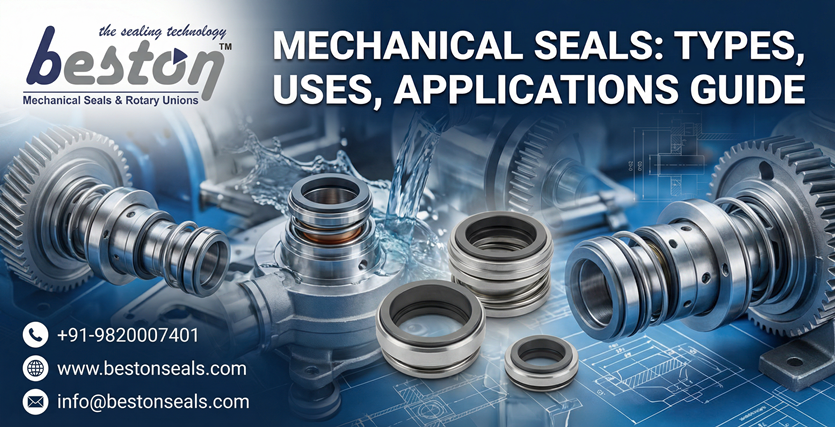
Mechanical seals are among the most critical components in pumps and rotating equipment. From chemical plants and refineries to pharmaceutical factories and food processing lines, nearly every industry depends on reliable sealing solutions to prevent leakage, protect equipment, and ensure safe operations.
A small seal failure can result in:
- Product loss
- Environmental hazards
- Equipment damage
- Expensive downtime
- Safety risks
That’s why selecting the right mechanical seal type for the right application is essential.
In this complete industry guide, we explain mechanical seal types, uses, applications, and industry selection criteria to help engineers, maintenance teams, OEMs, and procurement buyers make smarter decisions.
What is a Mechanical Seal?
A mechanical seal is a device used to seal the rotating shaft of equipment such as pumps, mixers, agitators, compressors, and reactors. It prevents process fluid leakage while allowing smooth shaft rotation.
Instead of traditional gland packing (which leaks and wears quickly), mechanical seals offer:
✔ Near-zero leakage
✔ Longer service life
✔ Better reliability
✔ Lower maintenance
✔ Improved energy efficiency
✔ Compliance with safety & environmental standards
Today, mechanical seals are the global standard for industrial sealing.
How Mechanical Seals Work?
Mechanical seals operate using two precision-machined faces:
- One rotating face
- One stationary face
These faces are pressed together by springs or bellows. A thin fluid film forms between them, minimizing friction while preventing leakage.
Supporting components include:
- Elastomers or bellows
- Springs
- Metal parts
- Seal support systems
Proper design and material selection ensure leak-free performance even under extreme pressure and temperature.
Main Types of Mechanical Seals
Mechanical seals are classified based on design, construction, and application. Understanding these types helps in choosing the right seal.
1. Pusher Mechanical Seals
Pusher seals use dynamic elastomers (O-rings) that move axially along the shaft to compensate for wear.
Common Types:
- Single spring mechanical seal
- Multi spring mechanical seal
- Conical spring mechanical seal
- Wave spring mechanical seal
Advantages:
✔ Cost-effective
✔ Compact
✔ Easy to maintain
✔ Widely available
Uses:
- Water pumps
- General industrial duty
- Light chemical services
- OEM pumps
These are the most commonly used seals worldwide.
2. Non-Pusher (Bellows) Mechanical Seals
Non-pusher seals use a flexible bellows instead of a sliding O-ring.
Types:
Advantages:
✔ No shaft wear
✔ High chemical resistance
✔ Handles higher temperatures
✔ Better for critical processes
Uses:
- Refineries
- Chemical plants
- Pharmaceuticals
- Corrosive services
Ideal for harsh and high-reliability environments.
3. Single Mechanical Seals
Single seals use one pair of seal faces.
Benefits:
✔ Economical
✔ Simple design
✔ Easy installation
Applications:
- Clean fluids
- Non-hazardous services
- Utility pumps
4. Double Mechanical Seals
Double seals use two sets of faces with buffer/barrier fluid between them.
Benefits:
✔ Zero leakage
✔ Maximum safety
✔ Longer life
✔ Suitable for hazardous fluids
Applications:
- Toxic chemicals
- Hydrocarbons
- Petrochemicals
- High-pressure pumps
Preferred for oil & gas and chemical industries.
5. Cartridge Mechanical Seals
Cartridge seals are pre-assembled units.
Benefits:
✔ Easy installation
✔ Reduced alignment errors
✔ Faster maintenance
✔ Improved reliability
Widely used in modern plants for reduced downtime.
Mechanical Seal Materials
Material selection directly affects performance and lifespan.
Seal Faces
Elastomers
- Viton
- EPDM
- Nitrile
- PTFE
- Kalrez
Metals
- SS316
- Hastelloy
- Inconel
- Alloy steels
Correct compatibility ensures resistance to heat, pressure, and chemicals.
Uses of Mechanical Seals
Mechanical seals are used wherever rotating shafts meet process fluids.
Primary Uses:
✔ Prevent fluid leakage
✔ Maintain pressure
✔ Protect bearings
✔ Reduce contamination
✔ Improve equipment life
✔ Enhance safety
They are essential in almost every industrial pumping and mixing system.
Applications of Mechanical Seals
Mechanical seals are installed in:
- Centrifugal pumps
- Positive displacement pumps
- Mixers
- Agitators
- Blenders
- Reactors
- Compressors
- Rotary joints
- Blowers
Any rotating equipment handling liquids requires a sealing solution.
Industry-Wise Applications of Mechanical Seals
Let’s look at how different industries use mechanical seals.
Oil & Gas and Petrochemicals
Used in:
- Hydrocarbon pumps
- Refinery processes
- Crude transfer
- Hot oil systems
Recommended:
✔ Double seals
✔ Metal bellow seals
✔ API seal support systems
These industries demand maximum safety and reliability.
Chemical & Process Industry
Used in:
- Acids and solvents
- Dyes & pigments
- Corrosive fluids
Recommended:
✔ PTFE bellow seals
✔ Double seals
✔ Chemical-resistant materials
Focus: corrosion resistance
Pharmaceutical & Food Processing
Used in:
- Sterile processing
- Clean media
- Hygiene-critical systems
Recommended:
✔ FDA-grade elastomers
✔ Cartridge seals
✔ Easy-to-clean designs
Focus: purity & contamination control
Water & Wastewater
Used in:
- Water transfer
- Sewage pumps
- Treatment plants
Recommended:
✔ Rubber bellow seals
✔ Single seals
Focus: cost-effective reliability
Power Generation
Used in:
- Boiler feed pumps
- Cooling systems
- High-pressure applications
Recommended:
✔ Heavy-duty seals
✔ Metal bellows
Focus: high temperature & pressure
OEM Pump Manufacturers
Used in:
- Standard equipment
- Export pumps
- Industrial machinery
Recommended:
✔ Compact pusher seals
✔ Cartridge designs
Focus: easy integration
How to Choose the Right Mechanical Seal?
Here’s a practical selection checklist:
Step 1 – Analyze Fluid
- Corrosive?
- Hazardous?
- Abrasive?
Step 2 – Check Operating Conditions
- Temperature
- Pressure
- RPM
Step 3 – Evaluate Risk Level
- Leakage tolerance
- Safety requirements
- Environmental compliance
Step 4 – Choose Seal Type
- General duty → Pusher seal
- High temp → Metal bellow
- Corrosive → PTFE bellow
- Hazardous → Double seal
- Easy installation → Cartridge seal
Step 5 – Consider Lifecycle Cost
Cheaper seals often fail faster. Reliability reduces downtime and saves more money long-term.
Common Mechanical Seal Failures
Causes:
- Dry running
- Improper installation
- Elastomer attack
- Heat buildup
- Misalignment
Prevention:
✔ Proper selection
✔ Correct materials
✔ Seal support systems
✔ Regular monitoring
Correct selection avoids 80% of failures.
Why Choose Beston Seals?
Beston Seals is a trusted manufacturer, supplier, and exporter of:
- Mechanical Seals
- Sealing Components
- Seal Support Systems
- Rotary Unions & Joints
Strengths:
✔ Wide product range
✔ CAD/CAM engineering
✔ Custom designs
✔ OEM replacement compatibility
✔ Export capability
✔ Competitive pricing
✔ Reliable quality control
Serving industries across India and global markets for over a decade.
Mechanical seals are the backbone of reliable pump performance across every industry. From basic water pumping to hazardous refinery operations, choosing the correct seal type directly impacts safety, uptime, and operating costs.
Understanding mechanical seal types, uses, applications, and industries allows businesses to select solutions that deliver long service life and dependable performance.
With the right design and trusted manufacturer, you can minimize downtime and maximize productivity.
FAQs
Q1. What are the main types of mechanical seals?
Pusher, non-pusher (bellows), single, double, and cartridge seals.
Q2. Which seal is best for chemical applications?
PTFE or metal bellow non-pusher seals.
Q3. Are double seals necessary for oil & gas?
Yes, for hazardous or flammable fluids.
Q4. How long do mechanical seals last?
Typically 1–3 years depending on application and conditions.
Q5. Can seals replace John Crane or Burgmann models?
Yes, OEM-compatible replacements are available.
Need help selecting the right mechanical seal?
Share your operating conditions or drawings with Beston Seals and get expert recommendations with a competitive quote.