
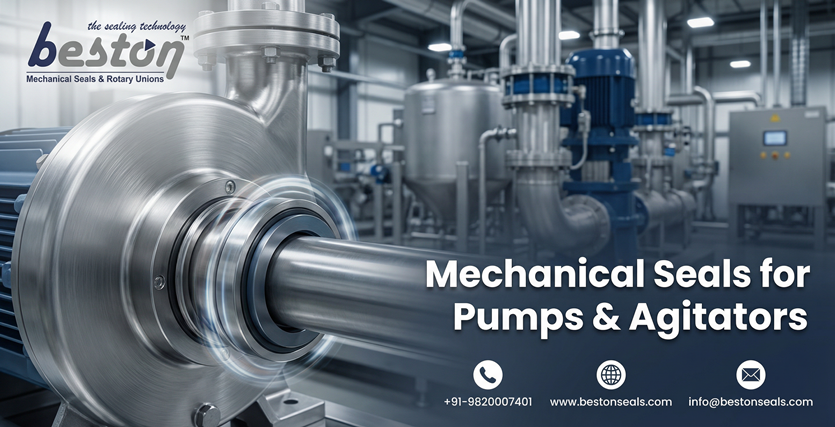
1. What Is a Mechanical Seal — and Why Does It Matter?
A mechanical seal is a precision-engineered device installed at the point where a rotating shaft enters a stationary pump casing or agitator housing. Its purpose is simple but critical: prevent the process fluid from leaking to the atmosphere while permitting the shaft to rotate freely.
Every mechanical seal consists of two ultra-flat faces — one rotating with the shaft and one stationary in the housing. These faces are lapped to a flatness tolerance of less than one micron (a fraction of a light band) and pressed together by a spring or bellows element. A thin lubricating film of process fluid between the faces prevents hard contact, reducing friction and wear.
Unlike traditional gland packing — which relies on compressed braided material and constant tightening — mechanical seals offer near-zero leakage, lower energy consumption, and dramatically longer service life. For industries handling hazardous, toxic, or expensive fluids, a properly selected mechanical seal is not optional; it is a regulatory and operational necessity.
Key Components of a Mechanical Seal
- Primary Seal Faces — The rotating face (attached to the shaft) and the stationary face (fixed in the gland or housing). These precision-lapped surfaces create the primary sealing barrier.
- Secondary Seals (O-Rings / Gaskets) — Static and dynamic elastomeric elements that seal between components and compensate for minor shaft movement.
- Spring / Loading Element — Maintains face contact by providing the closing force. It can be a single coil spring, multiple small springs, a wave spring, or a metal/elastomer bellows.
- Drive Mechanism — Pins, keys, or set screws that transmit torque from the shaft to the rotating seal assembly.
- Gland Plate — The housing that bolts to the equipment stuffing box and holds the stationary face, flush connections, and quench/drain ports.
2. Types of Mechanical Seals: A Complete Breakdown
Mechanical seals are classified by their construction, arrangement, and operating principle. Below is a comprehensive breakdown of every major seal type used in pumps and agitators today.
2.1 Pusher Mechanical Seals
Pusher seals use a dynamic secondary seal (typically an O-ring, V-ring, or wedge ring) that slides axially along the shaft or sleeve to compensate for face wear and shaft movement. They are the most widely used category of mechanical seals.
a) Conical Spring Mechanical Seals
The conical (tapered) spring acts as both the loading element and the drive mechanism. Its design enables the seal to handle higher shaft speeds without the spring “walking” or unwinding. Conical spring seals are compact, cost-effective, and widely used in general-purpose centrifugal pumps.
- Typical applications: Water pumps, cooling towers, HVAC systems, general chemical processing
- Pressure range: Up to 10–15 bar (unbalanced); up to 25 bar (balanced)
- Temperature range: –20°C to +180°C (depending on elastomer)
b) Single Spring Mechanical Seals
A single large-diameter coil spring provides the closing force. The robust design makes it resistant to clogging from solids, fibres, and crystallising media — ideal for dirty or viscous fluids where multiple small springs could become blocked.
- Typical applications: Pulp and paper mills, wastewater treatment, sugar mills, slurry handling
- Pressure range: Up to 10 bar (unbalanced); up to 20 bar (balanced)
- Temperature range: –20°C to +200°C
c) Multi Spring Mechanical Seals
Multiple small springs distributed evenly around the seal provide uniform face loading, resulting in more even wear and longer seal life. Multi spring seals are the preferred choice for high-speed applications and demanding process conditions.
- Typical applications: Chemical pumps, process water pumps, boiler feed pumps, refinery service
- Pressure range: Up to 15 bar (unbalanced); up to 30 bar (balanced)
- Temperature range: –40°C to +220°C
d) Wave Spring Mechanical Seals
Wave springs are manufactured from flat wire stock, providing an extremely compact axial profile. They are ideal for equipment with tight stuffing box spaces or where a minimal footprint is essential. Wave spring seals also generate very low face pressure at startup, protecting against dry-running damage.
- Typical applications: Close-coupled pumps, OEM equipment, mixers, small chemical pumps
- Pressure range: Up to 10 bar
- Temperature range: –20°C to +200°C
2.2 Non-Pusher (Bellows) Mechanical Seals
Non-pusher seals replace the dynamic O-ring with a bellows element — either metal or elastomeric — that flexes to compensate for face wear and shaft movement. Because there is no sliding O-ring on the shaft, non-pusher seals eliminate hang-up issues caused by shaft corrosion, deposits, or crystallisation, and are considered more reliable in harsh environments.
a) Rubber / Elastomer Bellows Mechanical Seals
The elastomer bellows acts as both the spring and the secondary seal. These are among the most economical and easy-to-install mechanical seals on the market. Widely used in water, wastewater, and light-duty chemical pumps where moderate temperature and pressure conditions exist.
- Typical applications: Municipal water pumps, domestic pumps, light chemical duty, HVAC
- Pressure range: Up to 10–12 bar
- Temperature range: –30°C to +140°C
- Key advantage: Self-aligning, cost-effective, easy replacement
b) PTFE Bellows Mechanical Seals
PTFE (Teflon) bellows seals offer exceptional chemical resistance against virtually all corrosive fluids, including strong acids, alkalis, and solvents. They are the go-to solution for pharmaceutical, food-grade, and aggressive chemical applications where elastomer degradation is a concern.
- Typical applications: Pharmaceutical processing, food and beverage, aggressive chemical handling, FDA-compliant systems
- Pressure range: Up to 6–10 bar
- Temperature range: –40°C to +200°C
- Key advantage: Near-universal chemical compatibility
c) Metal Bellows Mechanical Seals
Metal bellows seals use a welded or hydroformed thin-wall metal bellows as the spring and secondary seal. They offer the widest temperature range of any mechanical seal type and are the standard for high-temperature, high-pressure, and cryogenic applications. Metal bellows eliminate all elastomeric dynamic sealing elements — a critical advantage where O-ring materials would degrade or outgas.
- Typical applications: Hot oil systems, boiler feed pumps, thermal fluid circuits, reactor vessels, cryogenic service
- Pressure range: Up to 40 bar (balanced designs)
- Temperature range: –200°C to +400°C
- Key advantage: No dynamic elastomers; handles extreme temperatures
2.3 Cartridge Mechanical Seals
Cartridge seals are pre-assembled, pre-set, self-contained units that include the seal faces, springs, gland plate, and shaft sleeve as a single module. Unlike component seals that must be assembled piece by piece on the pump, a cartridge seal slides onto the shaft and bolts into place — dramatically reducing installation time and the risk of setting errors.
Cartridge seals are available in single, double (dual pressurised), and tandem (dual unpressurised) configurations.
- Typical applications: Critical process pumps, API 682 compliant systems, chemical and refinery pumps
- Pressure range: Up to 40+ bar (depending on design)
- Temperature range: Full range (depends on internal seal type — can include metal bellows)
- Key advantage: Fastest installation; no setting measurements needed; factory-tested reliability
2.4 Mechanical Seals for Agitators, Mixers, Reactors & Blenders
Agitators and mixers present unique sealing challenges that standard pump seals cannot handle. Agitator shafts experience significantly greater radial run-out (lateral shaft movement) — often 2–5 mm or more — compared to the tight tolerances of a centrifugal pump shaft (typically <0.05 mm). Additionally, agitators may operate at low speeds, variable speeds, or oscillating motion, and the sealed media is often viscous, abrasive, or operating under vacuum.
Purpose-built agitator seals feature wider seal face profiles, robust drive mechanisms, and specialised spring arrangements to accommodate this shaft movement without losing face contact. Double and tandem arrangements with barrier or buffer fluids are common for hazardous or vacuum applications.
- Typical applications: Chemical reactors, pharmaceutical mixing vessels, paint mixers, food blenders, polymerisation reactors
- Key advantage: Designed for high radial run-out, low/variable speed, and vacuum conditions
2.5 Split Mechanical Seals
Split seals are manufactured in two halves that clamp around the shaft, allowing installation or replacement without dismantling the pump, removing the impeller, or moving the motor. This makes them invaluable for large, heavy, or hard-to-access equipment where full disassembly would mean days of downtime.
- Typical applications: Large vertical pumps, mixers, slurry pumps, cooling water pumps, mine dewatering equipment
- Key advantage: Installed in situ; reduces downtime from days to hours
2.6 Component Mechanical Seals
Component seals are supplied as individual parts — rotating face, stationary seat, springs, O-rings, and hardware — assembled on site by the maintenance team. They demand skill and precision in setting the correct working height, but offer maximum flexibility for non-standard or legacy equipment where cartridge seals may not fit.
- Typical applications: Legacy pumps, non-standard equipment, OEM builds
- Key advantage: Maximum flexibility; often the lowest initial cost
Read more: Types of Mechanical Seals
3. How to Select the Right Mechanical Seal: 8 Critical Criteria
Choosing the wrong seal is the number-one cause of premature seal failure. Here are the eight parameters every engineer and procurement manager must evaluate:
1. Process Fluid Properties
What fluid is being sealed? Assess its chemical composition, corrosiveness, pH level, abrasives/solids content, tendency to crystallise, and viscosity. This dictates face material, elastomer grade, and metallurgy choice.
2. Operating Pressure
Determine the maximum pressure in the seal chamber (not the pump discharge). Pressures above 10–15 bar typically require a balanced seal to reduce face loading and heat generation.
3. Operating Temperature
The full temperature range — including startup, shutdown, and upset conditions — determines whether a standard elastomer (NBR, EPDM, Viton), a PTFE bellows, or a metal bellows seal is required. Above 200°C, metal bellows is almost always necessary.
4. Shaft Speed (RPM)
High shaft speeds increase frictional heat and centrifugal forces on the seal. Multi spring seals provide more uniform loading at high speed. Above 3,600 RPM, stationary spring designs may be preferred to avoid centrifugal effects unsettling the springs.
5. Shaft Size
The shaft diameter is the primary dimensional parameter for seal selection. All manufacturer cross-reference databases begin with shaft size. Standard metric sizes (e.g., 25 mm, 30 mm, 35 mm, 40 mm, etc.) are the most readily available.
6. Seal Chamber / Stuffing Box Dimensions
The bore diameter and depth of the seal chamber constrain which seal types will physically fit. Always verify dimensional compatibility against DIN 24960, EN 12756, or the pump manufacturer’s engineering drawing.
7. Equipment Type: Pump vs. Agitator
Pumps and agitators have fundamentally different shaft behaviour. Never install a standard pump seal on an agitator — the radial shaft run-out will destroy it within days. Specify a dedicated agitator seal designed for the higher deflection.
8. Regulatory & Environmental Requirements
For hazardous, toxic, or flammable fluids, regulations (such as API 682 in oil and gas, or FDA requirements in food and pharma) mandate specific seal configurations — usually dual seals with barrier fluids and auxiliary support systems.
Read more: How to Select the Right Mechanical Seal?
4. Seal Face Materials Compared
The seal face pair is the heart of every mechanical seal. The correct material combination directly determines seal life, leakage rate, and reliability.
| Face Material | Hardness (Mohs) | Max Temp (°C) | Chemical Resistance | Best For |
| Carbon Graphite | 1–2 | 300 | Good (most fluids) | General duty; paired with harder mating face |
| Silicon Carbide (SiC) | 9.5 | 450 | Excellent | Abrasive slurries, high pressure, high temp |
| Tungsten Carbide (TC) | 9 | 450 | Excellent (except strong alkalis) | Abrasive service, high-pressure hydrocarbon |
| Ceramic (Al₂O₃) | 9 | 250 | Good | Light duty, water service, cost-sensitive |
| PTFE / Carbon-filled PTFE | 2 | 200 | Outstanding (near-universal) | Corrosive chemicals, pharma, food |
Common face pairings:
- Carbon vs. SiC — The most popular general-purpose combination. Excellent lubricity and thermal dissipation.
- SiC vs. SiC — For the most abrasive and demanding services. Requires good lubrication.
- Carbon vs. Ceramic — Budget-friendly for water and light-duty applications.
- TC vs. TC — Used in high-pressure hydrocarbon services.
5. OEM Cross-Reference: John Crane / EagleBurgmann / Flowserve / Chesterton Equivalents
One of the most searched-for resources in the mechanical seal industry is a reliable cross-reference table for replacing OEM seals with equivalent alternatives. The table below maps major seal types from John Crane and EagleBurgmann to their functional equivalents, including Beston Seals.
⚠ Note: Cross-references are based on dimensional and functional similarity, not guaranteed identical performance. Always verify shaft size, seal chamber dimensions, face materials, and elastomer compatibility for your specific application before substitution.
| Seal Category | John Crane | EagleBurgmann | Flowserve / PAC-Seal | Chesterton | Beston Seals |
| Rubber Bellows (Standard) | Type 1 / Type 2 | MG1 / MG12 | PAC-Seal 21 | 110 | BRB Series |
| Rubber Bellows (Compact) | Type 21 / Type 2100 | MG13 / MG1S | 192 | 210 | BRB-C Series |
| Multi Spring (Unbalanced) | Type 8-1 | M7N / M74 | 140 / 155 | 491 | BMS-U Series |
| Multi Spring (Balanced) | Type 8B1 | H75 / H7N | 150 / 153 | 491HT | BMS-B Series |
| Conical Spring | Type 6 | MG920 | — | — | BCS Series |
| Single Spring | Type 1A | MG1/K | — | — | BSS Series |
| Wave Spring | Type 37 | — | 170 | — | BWS Series |
| Metal Bellows (Standard) | Type 609 / 680 | MFL85N | US2 | 186 | BMB Series |
| Metal Bellows (High Temp) | Type 670 / BX | H12 | 680 | 186HT | BMB-HT Series |
| Cartridge (Single) | Type 5610 / 5611 | Cartex-SN | ISC1PX | 155 / 155S | BCT-S Series |
| Cartridge (Dual / Double) | Type 5620 / 5625 | Cartex-DN | ISC2PP | 255 / 255S | BCT-D Series |
| Cartridge (Metal Bellows) | Type 5860 | Cartex-MB | ISC1MX | 182 | BCT-MB Series |
| Split Seal | Type 3740 | HSC | FSSN | 442 / S10 | BSP Series |
| Agitator / Mixer Seal | Type 10T / 1T | HSRL / SRC | SRIN | 680 / 682 | BAG Series |
| PTFE Bellows | — | — | — | — | BPB Series |
Need help identifying the right Beston equivalent for your OEM seal? Send us the existing seal model number and shaft size — our engineering team will provide a verified cross-reference within 24 hours.
6. Single Seal vs. Double Seal: When to Use Which?
| Parameter | Single Seal | Double / Dual Seal |
| Number of seal faces | 1 pair | 2 pairs |
| Barrier/buffer fluid | Not required | Required (pressurised or unpressurised) |
| Leakage to atmosphere | Minor (visible weepage possible) | Near-zero (barrier fluid leaks instead) |
| Cost | Lower | Higher (additional hardware + fluid) |
| Best for | Non-hazardous, non-toxic fluids | Hazardous, toxic, flammable, or expensive fluids |
| API 682 compliance | Arrangement 1 | Arrangement 2 (unpressurised) / Arrangement 3 (pressurised) |
Rule of thumb: If the process fluid is hazardous, toxic, carcinogenic, or if zero emission is mandated — always use a dual (double) seal arrangement with appropriate barrier/buffer fluid and an auxiliary support system (thermosyphon, heat exchanger, or pressurised reservoir).
Read more: Double Mechanical Seals vs Single Seals
7. Balanced vs. Unbalanced Mechanical Seals
| Feature | Unbalanced Seal | Balanced Seal |
| Hydraulic load on faces | Full system pressure | Reduced (via stepped sleeve) |
| Heat generation | Higher | Lower |
| Pressure limit | Typically <10–15 bar | Up to 40+ bar |
| Seal life | Shorter at higher pressures | Longer, more forgiving |
| Cost | Lower | Slightly higher |
When to choose balanced: Whenever the seal chamber pressure exceeds 10 bar, or when handling fluids with poor lubrication properties (light hydrocarbons, hot water) where excessive face heat would cause flashing.
Read more: Difference between Balanced vs. Unbalanced Mechanical Seals
8. Industry Applications
Mechanical seals are used across virtually every process industry. Here are some of the key sectors:
- Oil & Gas / Petrochemical — API 682 compliant cartridge seals, metal bellows for hot oil and hydrocarbon service
- Chemical Processing — PTFE bellows and SiC/SiC face pairs for aggressive chemicals
- Pharmaceutical & Food — FDA-compliant materials, CIP/SIP compatible designs, hygienic construction
- Water & Wastewater Treatment — Single spring seals for solids-laden water, rubber bellows for clean water
- Paper & Pulp Mills — Robust single spring designs that resist fibre and pulp clogging
- Power Generation — Metal bellows seals for boiler feed pumps operating above 200°C
- Steel & Metals — High-temperature rotary unions and seals for continuous casting and rolling mills
Read more: How to Choose the Right Mechanical Seal for Your Industry Application?
9. Frequently Asked Questions
Q: What is the difference between a pusher and a non-pusher mechanical seal?
A pusher seal uses a dynamic O-ring that slides along the shaft to follow face wear. A non-pusher seal uses a bellows (rubber, PTFE, or metal) that flexes instead of sliding, eliminating shaft hang-up issues caused by corrosion or deposits.
Q: Can I use a pump mechanical seal on an agitator?
No. Agitators experience much higher radial shaft run-out (2–5 mm) compared to pumps (<0.05 mm). Using a pump seal on an agitator will cause rapid face separation and premature failure. Always use a purpose-designed agitator seal.
Q: What causes mechanical seal failure?
The top causes are: dry running (insufficient face lubrication), incorrect installation or setting height, chemical attack on elastomers or faces, excessive vibration or shaft misalignment, thermal shock, and operating outside the pressure/temperature design envelope.
Q: How long should a mechanical seal last?
A properly selected and installed mechanical seal should deliver 2–5 years of service in typical industrial applications. Cartridge seals in well-maintained API 682 installations regularly exceed 3 years of continuous operation.
Q: What does API 682 specify?
API 682 is the international standard for mechanical seals in petroleum, chemical, and gas industries. It defines seal categories, types, arrangements, materials, testing protocols, and auxiliary piping plans to ensure maximum reliability and safety.
Q: Are Beston Seals interchangeable with John Crane and Burgmann seals? Yes. Beston Seals manufactures seals to international dimensional standards (DIN 24960 / EN 12756) and provides verified cross-reference equivalents for John Crane, EagleBurgmann, Flowserve, and Chesterton seal models. Contact our engineering team for a specific cross-reference.
10. Why Choose Beston Seals?
As one of India’s leading mechanical seal manufacturers and exporters, Beston Seals India Private Limited delivers:
- Complete product range — Pusher, non-pusher, cartridge, split, agitator, and component seals
- OEM interchangeability — Verified equivalents for John Crane, EagleBurgmann, Flowserve & Chesterton
- Engineered materials — SiC, TC, Carbon, Ceramic, and PTFE face combinations for every application
- Seal support systems — Thermosyphon systems, heat exchangers, and cyclone separators
- Global exports — Serving customers across the Middle East, Africa, Europe, and the Americas
- Fast turnaround — In-house manufacturing in Mumbai with rapid dispatch
Get Expert Help Selecting Your Mechanical Seal
Not sure which seal type fits your pump or agitator? Our application engineers will analyse your operating conditions and recommend the optimal seal — with a verified cross-reference if you’re replacing an existing OEM seal.
📋 Request a Free Consultation: bestonseals.com/contact-us/
📞 Call Now: +91-9820007401✉️ Email: info@bestonseals.com