
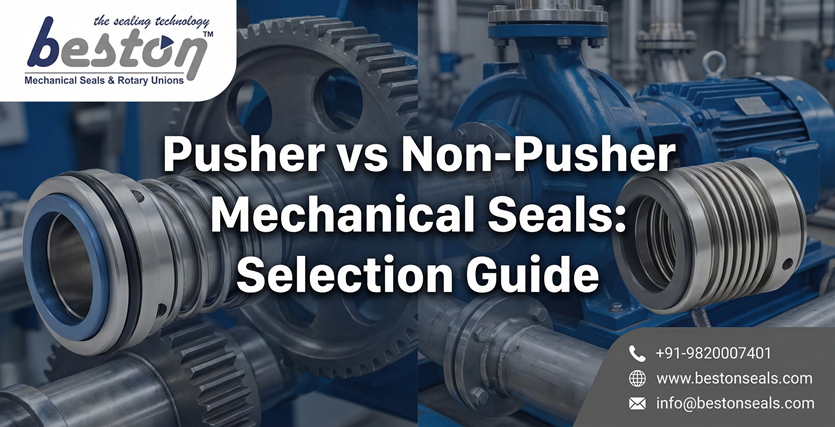
Mechanical seals play a critical role in preventing leakage, improving equipment reliability, and maintaining process safety in industrial pumps and rotating equipment. One of the most common questions faced by maintenance engineers, OEMs, and procurement teams is whether to choose a pusher mechanical seal or a non-pusher mechanical seal for a specific application.
This guide explains the key differences, working principles, applications, advantages, and selection criteria for pusher and non-pusher mechanical seals, helping industries make informed decisions for both domestic and global operations.
Understanding Mechanical Seal Basics
A mechanical seal is designed to seal the rotating shaft of equipment such as pumps, mixers, agitators, and reactors, preventing process fluid leakage while allowing smooth rotation. The seal consists of primary sealing faces, secondary sealing elements, springs or bellows, and metal components.
The primary classification—pusher vs non-pusher—is based on how the seal compensates for wear and shaft movement.
What Is a Pusher Mechanical Seal?
A pusher mechanical seal uses a dynamic secondary sealing element (usually an O-ring) that moves axially along the shaft or sleeve to compensate for wear of the seal faces.
Key Characteristics of Pusher Seals
- Uses O-rings or elastomers as secondary seals
- Springs push the seal faces together
- Axial movement occurs during operation
- Widely used in standard industrial pumps
Common Types of Pusher Mechanical Seals
- Single spring mechanical seals
- Multi spring mechanical seals
- Conical spring mechanical seals
- Wave spring mechanical seals
Typical Applications
- Water and wastewater pumps
- Oil transfer pumps
- General industrial pumping
- Chemical pumps with moderate conditions
- OEM pump installations
Advantages of Pusher Mechanical Seals
✔ Cost-effective
✔ Compact design
✔ Easy availability
✔ Wide application range
✔ Suitable for standard pressure and temperature
Limitations
- Elastomer degradation in aggressive chemicals
- Shaft wear due to O-ring movement
- Reduced reliability in high-temperature or dirty media
What Is a Non-Pusher Mechanical Seal?
A non-pusher mechanical seal, commonly known as a bellows mechanical seal, does not rely on a dynamic O-ring for axial movement. Instead, a flexible bellow compensates for wear, thermal expansion, and shaft movement.
Types of Non-Pusher (Bellows) Mechanical Seals
Key Characteristics
- No dynamic secondary sealing element
- No axial sliding on shaft
- Improved chemical and thermal performance
- Reduced shaft fretting
What is the Difference between a Pusher and a Non-Pusher Mechanical Seal?
Pusher vs Non-Pusher Mechanical Seals: Key Differences
| Feature | Pusher Mechanical Seal | Non-Pusher Mechanical Seal |
|---|---|---|
| Secondary Seal | Dynamic O-ring | Static bellows |
| Shaft Wear | Possible | Minimal |
| Chemical Resistance | Limited by elastomer | High (PTFE / metal bellows) |
| Temperature Handling | Moderate | High (metal bellows) |
| Maintenance | Moderate | Lower in harsh media |
| Cost | Lower | Higher initial cost |
| Typical Use | General duty | Critical process applications |
Applications Comparison
Where Pusher Mechanical Seals Are Preferred
- Clean or slightly contaminated fluids
- Moderate temperature and pressure
- Cost-sensitive applications
- Standard industrial pumps
- OEM equipment with defined tolerances
Where Non-Pusher Mechanical Seals Excel
- Aggressive chemicals and solvents
- High-temperature processes
- Vacuum and thermal cycling applications
- Pharmaceutical and chemical industries
- Refinery and petrochemical plants
Metal, Rubber & PTFE Bellows in Non-Pusher Seals
Metal Bellow Mechanical Seals
Best suited for:
- High-temperature fluids
- Hydrocarbons
- Hot oil systems
- Vacuum services
Industries:
Oil & Gas, refineries, power generation, petrochemicals
Rubber Bellow Mechanical Seals
Best suited for:
- Water and utility services
- Mild chemicals
- Low to medium temperature
Industries:
Water treatment, food processing, agriculture, OEM pumps
PTFE Bellow Mechanical Seals
Best suited for:
- Highly corrosive chemicals
- Acids and alkalis
- Solvent extraction
Industries:
Chemical processing, dyes, pharmaceuticals, APIs
How to Choose Between Pusher and Non-Pusher Mechanical Seals?
Selecting the right seal requires evaluating several parameters:
1. Process Fluid
- Corrosive or hazardous fluids → Non-pusher
- Clean, non-reactive fluids → Pusher
2. Operating Temperature
- High temperature (>150°C) → Metal bellow seal
- Normal temperature → Pusher or rubber bellow
3. Shaft Condition
- Shaft wear risk → Non-pusher
- Stable shaft → Pusher
4. Maintenance Strategy
- Long service intervals → Non-pusher
- Easy replacement → Pusher
5. Cost vs Reliability
- Lower initial cost → Pusher seal
- Higher lifecycle reliability → Non-pusher seal
OEM Replacement & Export Considerations
Both pusher and non-pusher mechanical seals are widely used as OEM replacements. High-quality seals can be designed to replace leading global brands such as:
- John Crane
- Burgmann
- Flowserve
- AES
- Chesterton
- Flex-A-Seal
- Vulcan
For export markets, compliance with material standards, dimensional accuracy, and application-specific customization are essential.
Why Beston Seals?
Beston Seals manufactures and supplies pusher and non-pusher mechanical seals with:
✔ CAD/CAM-based engineering
✔ Custom seal design as per drawings or samples
✔ Compatibility with global OEM brands
✔ Proven performance in domestic and export markets
✔ Support for chemical, pharmaceutical, refinery & OEM industries
There is no universal solution when choosing between pusher vs non-pusher mechanical seals. Pusher seals offer cost-effective performance for general applications, while non-pusher (bellows) seals provide superior reliability in aggressive, high-temperature, and critical process environments.
Understanding the differences and matching the seal design to operating conditions ensures longer equipment life, reduced downtime, and safer operations.
FAQs
Q1. What is the main difference between pusher and non-pusher mechanical seals?
Pusher seals use dynamic O-rings, while non-pusher seals use bellows to compensate for wear without shaft movement.
Q2. Are non-pusher seals better than pusher seals?
Not always. Non-pusher seals are better for harsh conditions, while pusher seals are economical for general applications.
Q3. Which seal is suitable for chemical applications?
PTFE or metal bellow non-pusher seals are ideal for chemical services.
Q4. Can pusher seals handle high temperature?
Only to a limited extent; metal bellow seals are preferred for high temperatures.
Q5. Are these seals interchangeable with OEM brands?
Yes, high-quality seals can replace major OEM mechanical seals when designed correctly.