
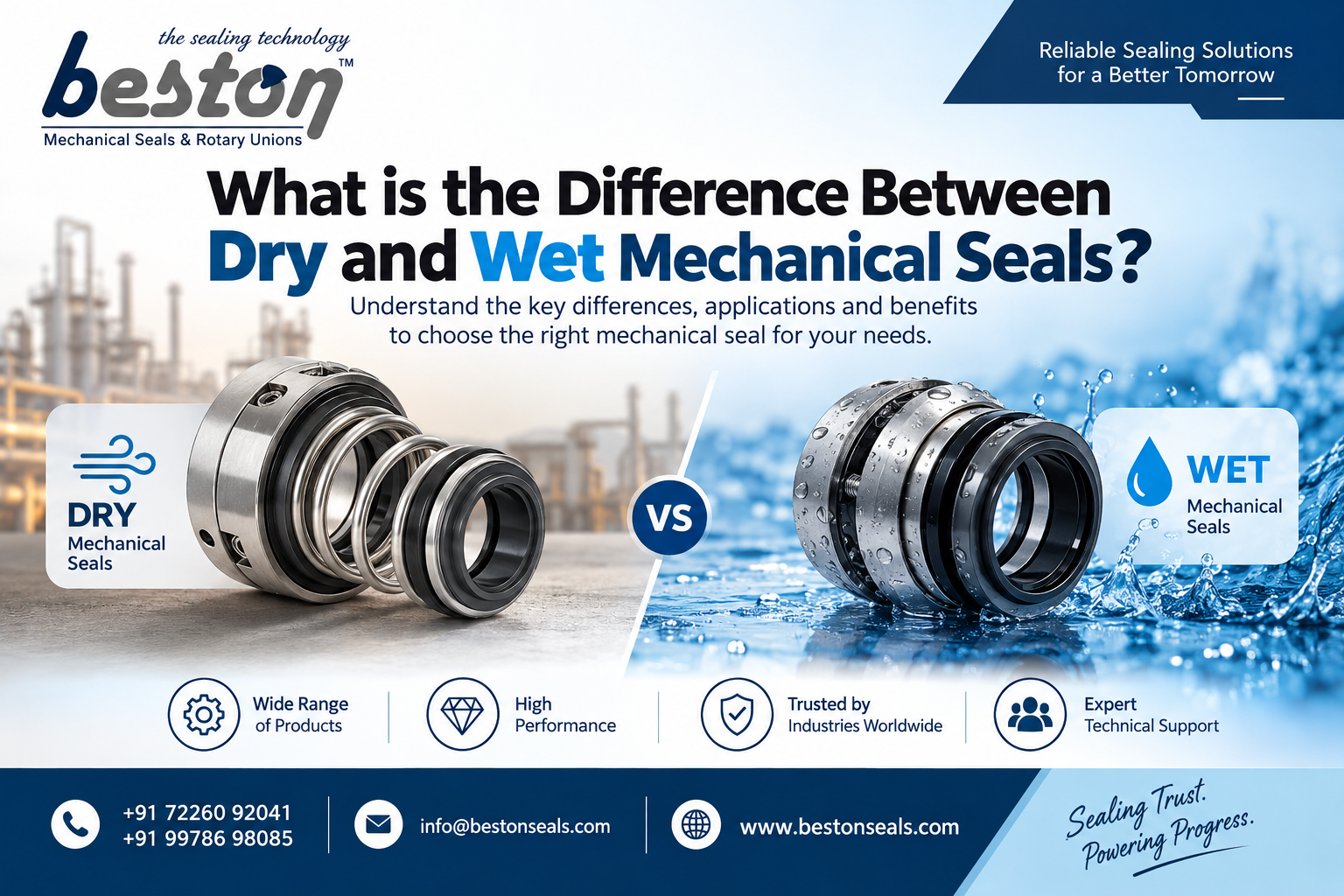
Mechanical seals play an important role in pumps, mixers, compressors, agitators and other rotating equipment. Their main purpose is to control leakage where a rotating shaft passes through a stationary housing. Choosing the correct seal is important because operating temperature, pressure, fluid characteristics, shaft speed and lubrication conditions can all affect seal performance.
Among the different mechanical seal types, dry and wet mechanical seals are two terms commonly used when discussing how the sealing faces are lubricated and cooled. Understanding the difference between dry and wet mechanical seals can help equipment operators and maintenance teams select a solution that suits their application.
What Are Mechanical Seals?
A mechanical seal normally consists of two precision sealing faces. One face rotates with the shaft while the other remains stationary. Springs or other loading mechanisms keep the faces correctly positioned, while secondary sealing elements help prevent leakage around the shaft and stationary components.
During normal operation, the sealing faces work with a very thin fluid or gas film. This film is important because it helps control friction, heat and wear. The exact sealing arrangement depends on the equipment and the process being handled.
What Is a Wet Mechanical Seal?
A wet mechanical seal uses a liquid at the sealing interface to provide lubrication and cooling. In many pump applications, the liquid being pumped provides this film. In other situations, an external flush, buffer fluid or barrier fluid may be supplied to support the seal.
Because liquid provides cooling and lubrication, wet seals are widely used in equipment handling liquids such as water, chemicals, oils and other process fluids.
A wet seal can be particularly useful when the process fluid provides suitable lubrication and does not create compatibility problems with the seal faces or elastomers.
However, the choice of wet seal should not be based simply on the fact that a liquid is present. The fluid’s temperature, viscosity, abrasiveness, chemical properties and ability to lubricate the faces should all be considered.
What Is a Dry Mechanical Seal?
A dry mechanical seal is designed to operate without conventional liquid lubrication at the sealing interface. However, the term “dry” can describe different technologies.
For example, dry gas seals used in compressors can use specially engineered grooves to generate a thin gas film that separates the sealing faces during operation. This allows the seal to operate without circulating seal oil while maintaining controlled separation between the faces.
This is different from simply allowing a conventional wet mechanical seal to run without liquid. A standard liquid-lubricated seal can suffer rapid overheating and wear if its lubrication film is lost.
Dry sealing technology is commonly associated with applications where contamination from liquid lubricants must be avoided or where gas handling requires a specialised sealing arrangement.
Dry vs Wet Mechanical Seals: Key Differences
The easiest way to understand dry vs wet mechanical seals is to compare their operating environment.
Lubrication: Wet seals use a liquid film for lubrication and heat management. Dry sealing systems avoid conventional liquid lubrication and may use gas-film technology or specially selected materials, depending on the design.
Cooling: Wet seals can benefit from the cooling effect of the process or barrier fluid. Dry systems require their own method of managing heat generated at the sealing interface.
Application: Wet mechanical seals are widely used in pumps handling liquids. Dry gas seals are commonly used in specialised gas-handling equipment such as compressors.
Contamination: A wet seal may introduce or allow interaction with a seal liquid, depending on its arrangement. Dry systems can be advantageous where oil or liquid contamination needs to be minimised.
Operating conditions: Dry sealing systems can be highly dependent on correct pressure, speed, gas quality and equipment operating conditions. Wet seals are also sensitive to operating conditions, particularly when the process fluid cannot adequately lubricate or cool the faces.
Which Mechanical Seal Should You Choose?
There is no universal answer when selecting between dry and wet sealing technology. The correct choice depends on the equipment and process.
Before selecting a seal, consider:
- Type of equipment and shaft speed
- Operating and maximum pressure
- Process fluid or gas
- Temperature range
- Fluid viscosity and lubricating properties
- Presence of abrasive particles or solids
- Chemical compatibility
- Required leakage control
- Availability of flush, buffer or barrier systems
- Maintenance requirements
- Environmental and contamination considerations
For liquid pumps, a properly selected wet mechanical seal may be appropriate when the process fluid can provide adequate lubrication and cooling. For specialised gas-handling applications, a dry gas sealing arrangement may be more suitable.
Why Correct Seal Selection Matters
A mechanical seal is a relatively small component, but its performance can directly affect equipment reliability. Incorrect face materials, unsuitable elastomers, inadequate lubrication, poor installation or operating outside the design conditions can all contribute to premature failure.
It is also important to remember that “dry” should never be interpreted as “any mechanical seal can safely operate without fluid.” A conventional liquid mechanical seal that loses its lubrication film can experience rapid heat generation and face damage.
Mechanical Seals from Beston Seals
Selecting the right sealing solution requires more than simply choosing between dry and wet designs. The seal needs to match the equipment, operating conditions and process fluid.
Beston Seals provides mechanical sealing solutions for industrial applications where reliable leakage control and equipment performance are important. When choosing a mechanical seal, discussing the actual operating conditions with a knowledgeable seal supplier can help identify the appropriate design, materials and configuration.
Final Thoughts
The main difference between dry and wet mechanical seals is the way the sealing interface is lubricated, cooled and controlled during operation. Wet mechanical seals generally rely on a liquid film, while dry sealing technologies are designed to operate without conventional liquid lubrication and may use a controlled gas film or specialised sealing materials.
Understanding these differences is the first step. The final selection should always consider the pump or equipment design, process medium, temperature, pressure, speed and required operating reliability. Choosing a seal based on the actual application—not simply its name—can help reduce premature failures, maintenance problems and unplanned downtime.