
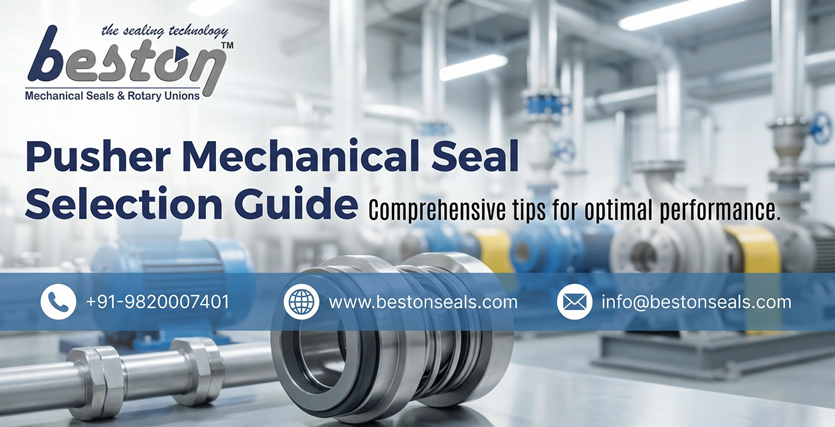
Mechanical seals play a critical role in maintaining process reliability, preventing leakage and ensuring equipment uptime in industrial pumping systems. Among the many seal configurations available in the market, pusher mechanical seals remain one of the most widely adopted solutions for rotating equipment due to their versatility, cost effectiveness and compatibility with a wide range of operating conditions.
Industrial sectors such as chemical processing, pharmaceuticals, petrochemicals, oil & gas, dyes, power generation, food processing, water treatment and plastics rely heavily on pusher seals for pump units, mixers, agitators, reactors, compressors and blowers.
This guide compares the four common spring mechanisms used in pusher mechanical seals:
✔ Single Spring Mechanical Seals
✔ Multi Spring Mechanical Seals
✔ Conical Spring Mechanical Seals
✔ Wave Spring Mechanical Seals
By the end, procurement engineers, maintenance managers and OEMs will be able to determine the right spring design based on process parameters, equipment type and application requirements.
What Is a Pusher Mechanical Seal?
A pusher mechanical seal is a type of seal that uses axial movement of the secondary sealing element (usually an elastomer) to compensate for face wear and maintain contact between the rotating and stationary faces.
These seals are typically:
- Dynamic O-ring driven
- Suitable for moderate to high-pressure systems
- Compatible with various media (clean liquids, oils, chemicals, light slurries)
- Available in balanced and unbalanced configurations
- Versatile across pump and mixer categories
Importance of Spring Design in Pusher Seals
While seal faces and materials receive much attention, spring design is often the hidden performance differentiator. Spring mechanisms directly impact:
✔ Torque transmission
✔ Seal face loading
✔ Heat generation
✔ Axial movement compensation
✔ Pressure handling
✔ Media compatibility
✔ Installation complexity
✔ Maintenance cycle life
Different process industries require different spring configurations depending on media viscosity, pressure, RPM range and equipment geometry.
Comparing Spring Types in Pusher Mechanical Seals
Below is a detailed analysis of the four prevalent spring designs.
1. Single Spring Mechanical Seals
Overview:
Single spring seals are driven by one coil spring transmitting uniform pressure to the seal faces.
Advantages:
- Simple construction
- Easy installation
- Cost-effective
- Good for clean liquids
Best Suited For:
✔ Water pumps
✔ Centrifugal process pumps
✔ General utility pumping
Industries Using Single Spring Seals:
- Water & wastewater
- Agriculture
- HVAC
- Plastics
- OEM general pumping
Limitations:
✖ Not ideal for high vibration
✖ Not suitable for viscous media or slurries
2. Multi-Spring Mechanical Seals
Overview:
Multi-spring seals use several small springs arranged circumferentially, enabling uniform face loading and enhanced balance.
Key Advantages:
✔ Better heat distribution
✔ Handles higher RPM
✔ Improved dynamic movement
✔ Higher pressure compatibility
✔ Lower face wear rates
Best Applications:
- High-speed centrifugal pumps
- Petrochemical processing
- Chemical transfer systems
- Petroleum refining plants
- Fertilizer & solvent industries
Industries Using Multi-Spring Seals:
✔ Petrochemical
✔ Chemical processing
✔ Oil & gas
✔ Pharmaceuticals
✔ Power plants
This category is widely adopted in global standards and OEM pump manufacturing due to consistency and reliability.
3. Conical Spring Mechanical Seals
Overview:
Conical spring mechanical seals utilize a tapered spring design that prevents clogging and allows torque transmission in one direction.
Advantages:
✔ Self-cleaning spring design
✔ Suitable for dirty media
✔ Allows bidirectional or unidirectional torque transfer
✔ Handles moderate viscosity media
Typical Use Cases:
- Dyes & pigments
- Paper & pulp processing
- Ceramics & mining slurry
- Pumping systems prone to clogging
Industries Adopting Conical Spring Designs:
✔ Dyes & chemical manufacturing
✔ Paints & coatings
✔ Pulp & paper
✔ Wastewater & effluent treatment
4. Wave Spring Mechanical Seals
Overview:
Wave spring seals use a compact wave spring that exerts uniform axial load while minimizing radial space.
Advantages:
✔ Compact axial profile
✔ Excellent for limited space
✔ Uniform spring force
✔ Supports balanced seal designs
✔ Good for thermal variations
Common Applications:
- Reactor & agitator shafts
- High-speed processing equipment
- Compact OEM pumps
Industries Using Wave Spring Seals:
✔ Pharmaceuticals
✔ Fine chemicals
✔ Food processing
✔ Solvent extraction plants
Wave springs are popular where machinery footprint and housing geometry impose constraints.
Key Selection Criteria for Choosing the Right Pusher Seal
Procurement teams, design engineers and maintenance departments should evaluate:
1. Process Fluid Compatibility
✔ Corrosiveness
✔ Abrasiveness
✔ Particle content
✔ Viscosity
✔ Chemical concentration
2. Mechanical Parameters
✔ Shaft RPM
✔ Shaft runout & vibration
✔ Pump type (centrifugal, screw, reciprocating)
✔ Media pressure & temperature
3. Environmental & Safety Factors
✔ Emission requirements
✔ Leakage tolerance
✔ Seal support systems (thermosyphon, heat exchangers, etc.)
4. Seal Face & Secondary Materials
Typical options include:
- Silicon Carbide
- Tungsten Carbide
- Ceramic
- Carbon
- PTFE
- Viton / EPDM / Kalrez elastomers
5. Global OEM Replacement Compatibility
Pusher seals are frequently specified as replacements for:
- John Crane
- Burgmann
- Flowserve
- AES
- Chesterton
- Flex-a-Seal
- Vulcan
Export buyers increasingly demand equivalent models matching OEM specifications to reduce lifecycle costs while maintaining reliability.
Why Industries Choose Pusher Seals for Pumping Systems?
Pusher seals offer:
✔ Interchangeability
✔ Wide material availability
✔ Global compatibility
✔ Lower maintenance downtime
✔ Balanced cost vs reliability
This makes them attractive for plants aiming to improve MTBR (Mean Time Between Repairs).
Beston Seals: Global Manufacturer & Exporter
Beston Seals manufactures a comprehensive range of pusher mechanical seals with single, conical, wave and multi-spring configurations engineered for industrial rotating equipment.
Highlights:
✔ CAD/CAM powered design
✔ CNC manufacturing
✔ Material traceability
✔ Seal support systems
✔ OEM replacement compatibility
✔ Export-ready reliability
Industries served:
- Chemicals & Petrochemicals
- Pharmaceuticals
- Solvent Extraction
- Power Generation
- Oil & Gas
- Food Processing
- Textiles & Plastics
- Pulp & Paper
- Mining & Steel
- OEMs + EPC Contractors
Looking for the right pusher seal for your pumping system?
📩 Request a Quote
📎 Share Drawings or Specifications
🔄 Replacement for OEM Models Available
🌍 Export & Domestic Supplies Supported
Frequently Asked Questions (FAQs)
Q1. Are pusher seals suitable for abrasive media?
Yes, with the right spring configuration (conical/multi) and face materials like Tungsten Carbide.
Q2. Which seal is best for high RPM pumps?
Multi-spring seals provide superior dynamic stability at higher speeds.
Q3. Can pusher seals operate in high-temperature applications?
Yes, provided elastomers and metallurgy are selected appropriately.
Q4. Do pusher seals support bidirectional rotation?
Conical spring and wave spring designs can be configured for bidirectional torque transfer.
Q5. Are OEM replacements available for branded mechanical seals?
Yes, Beston Seals offers compatible replacements for leading OEM brands.