
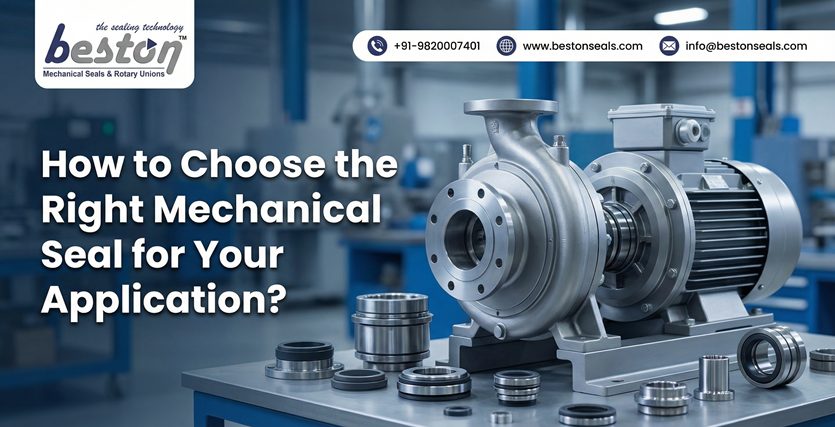
Best Tips to Select the Right Mechanical Seal for Your Application
Mechanical seals play a critical role in maintaining equipment reliability, reducing leakage, improving safety and increasing lifecycle performance in industrial plants. However, choosing the right seal is not always straightforward. The wrong seal configuration can lead to premature seal failure, downtime, production losses, contamination and costly maintenance shutdowns.
Whether you operate in chemicals, petrochemicals, fertilizers, pharmaceuticals, food processing, water management, power generation, or OEM machinery manufacturing — seal selection directly impacts operational efficiency and cost optimization.
In this guide, we explain how to choose the right mechanical seal for your application, what selection parameters matter, and why industries increasingly prefer engineered sealing solutions from leading manufacturers like Beston Seals.
Key Factors to Consider When Choosing a Mechanical Seal
1. Understand Your Industry and Process Requirements
Mechanical seals are selected based on the process conditions of the equipment where they are installed. Before shortlisting, you should define:
✔ Nature of media (water, chemicals, solvents, slurries, gases)
✔ Temperature & pressure range
✔ Equipment speed (RPM) & shaft size
✔ Equipment type (pump, mixer, agitator, reactor, blower)
✔ Operating environment (hazardous, hygienic, food-grade, pharma)
✔ Industry regulatory standards (API, GMP, FDA, ATEX, ISO)
For example:
- Chemical plants require seals that resist corrosive media and solvents.
- Petrochemical & oil & gas applications need seals that comply with API standards.
- Food & pharma applications require hygienic & contamination-free sealing.
- Paper, steel & textile industries require seals compatible with slurries and abrasive particulates.
Understanding the process environment is the foundation of correct seal selection.
2. Choose Between Single and Double Mechanical Seals
The first major selection decision is whether the application needs a single or double mechanical seal.
Single Mechanical Seal
A single seal is the most common configuration and is suitable when:
✔ Media is non-toxic, non-abrasive, non-hazardous
✔ Minor leakage is acceptable
✔ Operating pressures are moderate
✔ Used in water, non-corrosive liquids, utilities, HVAC, and general industrial pumps
Double Mechanical Seal
A double seal is used when:
✔ Media is hazardous, toxic, flammable or explosive
✔ Zero leakage or vapor emission is required
✔ Equipment handles corrosive chemicals, solvents or slurries
✔ Required by environmental regulations or plant safety standards
✔ Used in petrochemical, pharmaceutical, chemical & fertilizer units
Double seals often require a seal support system such as a thermosyphon, ensuring lubrication and cooling for safe seal performance.
3. Select the Seal Type Based on Application
Mechanical seals come in multiple configurations:
Pusher Seals
- Use secondary elastomer
- Handle shaft misalignment
- Suitable for general-duty pumps and moderate temperatures
Non-Pusher Seals
- Use bellows (metal, PTFE, or rubber)
- No dynamic elastomer movement
- Suitable for corrosive media and high temperature
Cartridge Seals
- Pre-assembled with sleeve, gland & fasteners
- Easier installation & lower installation errors
- Preferred for OEMs and plant maintenance teams
Agitator & Mixer Seals
- Designed for axial movement and vibration
- Used in reactors, blenders & pharmaceutical mixers
Dry Running & Gas Seals
- Operate without external lubrication fluid
- Used where contamination must be avoided
Choosing the correct category ensures optimal sealing performance.
4. Material Compatibility is Critical
Seal material selection depends on the media and operating conditions.
Face Materials
Common face pairings include:
| Media Type | Recommended Face Pair |
| Clean water | Carbon vs Ceramic |
| Corrosive chemicals | Silicon Carbide vs Silicon Carbide |
| Abrasives & slurries | Tungsten Carbide vs Tungsten Carbide |
| High temperature | Silicon Carbide / TC |
| Food & pharma | Carbon vs Ceramic (FDA grade) |
Elastomer Materials
| Media | Elastomer |
| Water & mild fluids | NBR |
| Oils | FKM (Viton) |
| Chemicals | PTFE |
| High Temp | FFKM / FKM |
| Pharma / Food | EPDM (FDA grade) |
Choosing incorrect elastomers is a common reason for seal failure.
5. Operating Pressure, Temperature & Speed Matter
Seal performance is heavily influenced by:
✔ Pressure (balanced vs unbalanced seals)
✔ Temperature (cooling, thermal stability)
✔ Shaft speed (face stability & lubrication)
✔ Media viscosity & lubricity
For example:
- High-pressure applications require balanced seals to reduce seal face load.
- High-temperature applications may require metal bellows.
- High RPM applications require engineered face flatness & lubrication.
6. Consider Environmental & Safety Regulations
Industries like oil & gas, chemicals, pharmaceuticals and food processing operate under strict compliance codes such as:
✔ API 682
✔ ATEX
✔ GMP
✔ FDA
✔ ISO
✔ EPA Emission Requirements
Selecting seals that comply with regulatory framework reduces audit risks, leaks and shutdown issues.
7. Support Systems Improve Seal Life
For double seals, support systems like:
✔ Thermosyphon systems
✔ Heat exchangers
✔ Cyclone separators
help maintain:
✔ cooling
✔ lubrication
✔ barrier fluid circulation
✔ contamination prevention
These systems significantly increase seal lifespan and reduce maintenance downtime.
8. Seal Replacement vs OEM Equivalents
Many industries prefer replacement equivalents instead of OEM imported seals for cost and availability reasons.
Beston Seals offers equivalents compatible with global brands such as:
✔ John Crane
✔ Burgmann
✔ Flowserve
✔ AES
✔ Chesterton
✔ Flex-a-Seal
✔ Vulcan
✔ Roten
✔ Roplan
This gives plant procurement the flexibility to:
✔ reduce cost
✔ reduce lead time
✔ achieve compatibility
✔ localize supply
9. Why Industries Choose Beston Seals
Beston Seals is trusted by OEMs, EPCs, and industrial plants because we offer:
✔ Wide sealing solutions for pumps, agitators & reactors
✔ Material compatibility for corrosive & hazardous chemicals
✔ Seals engineered for extreme pressure & temperature
✔ Replacement compatibility with global brands
✔ In-house R&D, testing & QC
✔ Export-grade packaging & global supply capability
Industries served include:
- Dyes & Chemicals
- PVC Film
- Petrochemical
- Oil & Gas
- Fertilizer Plants
- Pharma & Biotech
- Food Processing
- Steel & Paper
- Textile & Rubber
- OEM Machinery Manufacturers
📌 Final Advice: Don’t Select Seals Blind — Consult Experts
Seal selection is a technical decision that impacts both operational safety and cost efficiency. The best approach is to involve a seal specialist who can verify process parameters and recommend the correct configuration.
📩 Need Support? Request a Technical Consultation
If you need help choosing the right seal for your plant or OEM machinery:
👉 Request a Specification Match
👉 Send us Media & Process Details
👉 Submit an RFQ
👉 Ask for Replacement Compatibility
👉 Request Export Order Support
Beston Seals provides application engineering support for both domestic and international clients.
Contact us to get the right sealing solution for your application.
Frequently Asked Questions (FAQs)
1. How do I know which mechanical seal is suitable for my application?
To determine suitability, evaluate your media properties, operating pressure, temperature, shaft speed, equipment type and environmental regulations. Sharing these parameters with seal manufacturers allows them to recommend the correct seal configuration.
2. What is the difference between single and double mechanical seals?
Single mechanical seals allow limited leakage and are suitable for non-hazardous media, while double seals prevent leakage completely and are recommended for hazardous, toxic, corrosive or regulated applications like chemical, pharma and petrochemical industries.
3. Which industries commonly use double mechanical seals?
Double seals are commonly used in chemicals, petrochemicals, oil & gas, fertilizers, pharmaceuticals, food processing, and wastewater treatment industries where containment, safety and compliance are critical.
4. How important is material compatibility in seal selection?
Material compatibility is crucial as incorrect seal faces or elastomers can lead to chemical attack, swelling, corrosion, premature failure or leakage. Face pairs like SiC–SiC or TC–TC are chosen for corrosive or abrasive media.
5. Do mechanical seals require external support systems?
Some seals, especially double mechanical seals, use support systems like thermosyphons, heat exchangers or cyclone separators to circulate barrier fluid, cool sealing faces and improve performance and seal life.
6. Can mechanical seals be replaced with equivalent OEM alternatives?
Yes. Many industries use equivalent replacement seals to reduce cost and lead time. Beston Seals provides compatible solutions for major global brands such as John Crane, Burgmann, Flowserve, AES, Chesterton and others.
7. What information should I provide when requesting a mechanical seal quote?
Provide details like media, temperature, pressure, shaft size, RPM, equipment type, expected sealing performance, and whether the application is hazardous or food-grade. Drawings or samples also help match specifications.
8. Does Beston Seals export mechanical seals globally?
Yes. Beston Seals exports mechanical seals, rotary unions and seal support systems worldwide and supports OEMs, EPCs, distributors and industrial plants with technical documentation and compliance support.
9. How can I get assistance selecting the correct seal?
You can request a technical consultation from Beston Seals. Our engineering team assists with application evaluation, seal selection, compatibility matching and replacement recommendations based on your process conditions.